
Updated November 2026: We first published this guide in January 2019, after our own trek in April 2018. Since then Nepal has changed its guide rules, its permits and the way you fly to Lukla, so we’ve rewritten the whole guide for the 2027 trekking season. Where something changed, we tell you how it was in our time and how it is now.
Back in April 2018, two self-declared couch potatoes (one of them with asthma) walked from Lukla to Everest Base Camp and back without a guide or porter. We carried our own bags, picked our own teahouses and spent about $1,500 for the two of us, flights and gear included. Our guide to doing it yourself became the most-read article on this blog.
But a lot has changed in Nepal since then. In April 2023, Nepal made a licensed guide mandatory for foreign trekkers in its national parks and conservation areas. Since then we get the same question again and again: “Is it still possible to do EBC on our own?”
Short answer: yes, the Everest region is the exception. Here’s everything that changed, what it costs now, and what you need to know before you go.

Is A Guide Mandatory For The Everest Base Camp Trek?
No, not on the classic EBC route. Nepal’s guide rule applies nationwide, but the local authority of the Everest region, the Khumbu Pasang Lhamu Rural Municipality, refused to apply it in its area. Its reasoning: the trails in the Khumbu are busy and well marked, there are teahouses in every village, and local rescue is well organised. So independent and solo trekkers are still welcome.
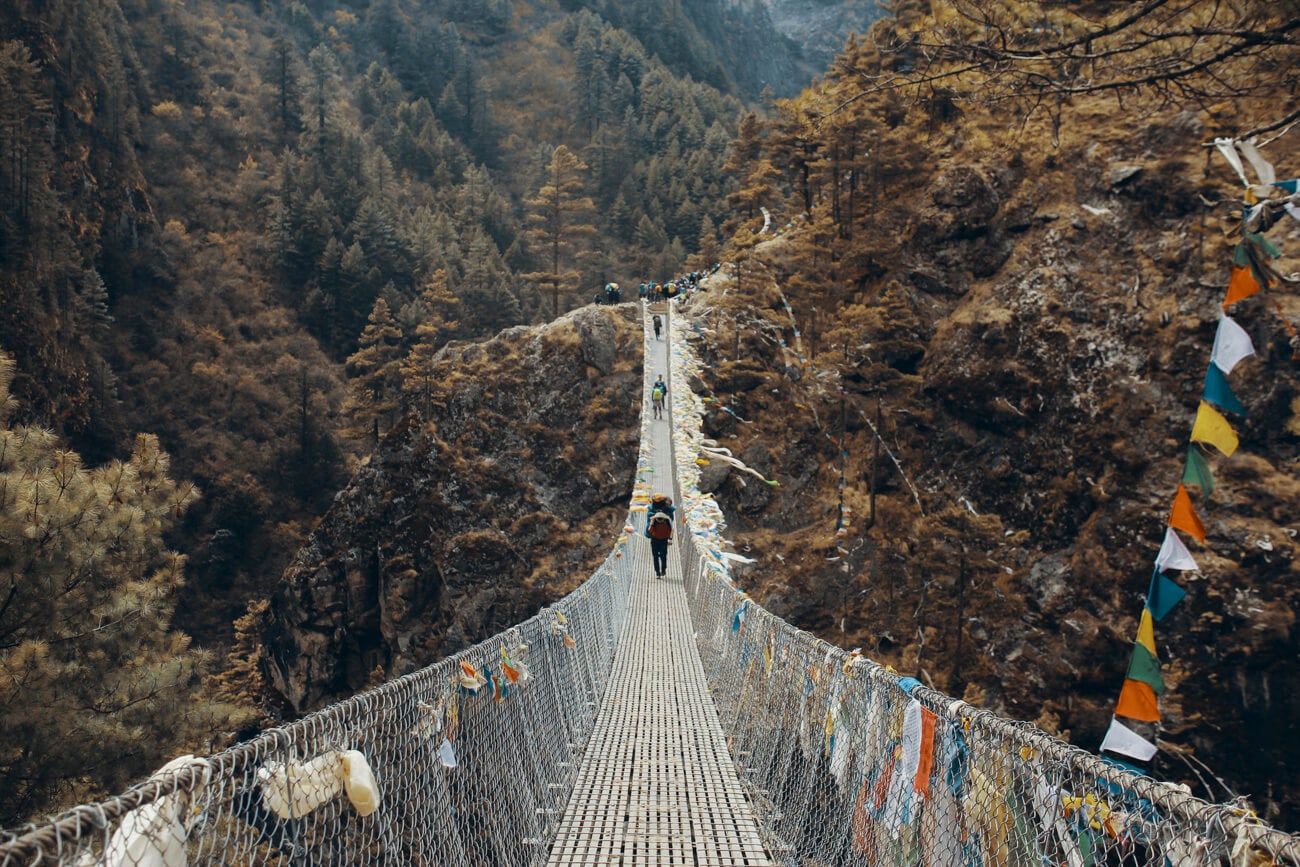
That matches what we saw ourselves. The trail is so busy, especially between Lukla and Namche, that getting lost is practically impossible.

Watch out though: the exception only covers the Everest region. Want to add a climbing peak like Island Peak, or trek Annapurna, Langtang or Manaslu afterwards? Then you need a licensed guide (and for Manaslu, Mustang, Dolpo or Kanchenjunga, a registered agency too).
Travel tip: Rules in Nepal change fast. That’s exactly why we’re updating this post! Check the latest situation with the Nepal Tourism Board in Kathmandu just before you start your trek.
Which Permits Do I Need In 2027?
In our original guide we wrote that the TIMS card had become useless. That’s still true: on the EBC route you don’t need one. You need two permits:
- Khumbu Pasang Lhamu Rural Municipality permit: NPR 3,000 per person (it was NPR 2,000 when we went; it went up in 2025). You can only get this one on the trail: at the entrance of Lukla if you fly in, or at Monjo if you walk in from Jiri or Salleri.
- Sagarmatha National Park entry permit: NPR 3,000 per person, plus 13% VAT at some counters (we paid NPR 3,390 in 2018). You can buy it at the Nepal Tourism Board office in Kathmandu or at the park gate in Monjo.
That’s about NPR 6,000 to 6,400 per person, roughly $45 to $50. Bring cash: there’s no card machine at the checkpoints, and the ATMs in Namche still let you down regularly.

Flying To Lukla: The Big Change
This one surprises most people. In peak season (spring and autumn), most flights to Lukla no longer leave from Kathmandu but from Ramechhap (Manthali), a 4 to 5 hour drive away. Kathmandu airport simply gets too busy for all those little planes.
What that means for you:
- Expect a very early start. Shuttles to Ramechhap often leave Kathmandu around 1 or 2 AM to catch the morning flights.
- The flight itself is short: about 20 minutes from Ramechhap instead of 35 from Kathmandu.
- Prices: count on roughly $175 to $210 one way from Ramechhap, plus $25 to $30 for the shared transfer. Direct flights from Kathmandu, outside peak season, are around $215 to $255 one way.
In 2018 we paid $640 for two return tickets. Today a return ticket costs about $360 to $510 per person, so flying in is a lot pricier than it used to be. Want to save? Walking in from Jiri, or taking the new jeep road to Surke, costs you a few extra days but far less than the flights. Read all about it in our guide to flying to Lukla.
Travel tip: Always plan one or two buffer days at the end of your trek. Lukla flights get cancelled for bad weather all the time, and you don’t want to miss your international flight because of it.
What Does The Trek Cost Now?
For reference, here’s what we paid in 2018 for the two of us (17 days in the Khumbu):
- Trekking gear bought in Thamel: $255
- Flights in & out of Lukla: $640
- Trekking permits: $100
- Food: $475
- Accommodation: $15
- Miscellaneous (books & meds): $23
- Total: $1,508
The biggest increases since then are the flights and the permits. Our trick to sleep for (almost) nothing still works in most teahouses: eat all your meals there and many owners will give you the room for free or very cheap. And Dal Bhat is still the best deal on the mountain: cheap, filling, and in most lodges you get a free refill. Dal Bhat Power, 24 Hour!

Should You Go Without A Guide?
It’s legal, but that doesn’t make it the right choice for everyone. We still think doing it on your own is one of the most rewarding things you can do: your own pace, your own itinerary, and a huge sense of pride when you reach Base Camp. But be honest with yourself:
- Altitude sickness is still the biggest danger, guide or not. Go slow, plan acclimatisation days, and never ascend with symptoms. You can still catch the free talk on altitude sickness every afternoon at the aid post in Pheriche.
- If you go solo (rather than as a pair, like we did), leave your itinerary with your teahouse every morning.
- Get travel insurance that explicitly covers helicopter evacuation at high altitude. Without that proof, a rescue can cost you thousands before the helicopter even takes off.
Want a guide but not a full tour? You can hire a local guide or porter in Lukla or Namche. You support the local economy and still keep plenty of freedom.

When Is The Best Time To Go?
Still the same: spring (April–May) and autumn (October–November) give you the clearest skies, and the most people. We went in the second half of April, right in the middle of peak season, and the stretch to Namche was crowded. Our advice hasn’t changed: go just before or just after peak season.

Our Verdict
The Everest Base Camp trek without a guide is still very much possible. It’s more expensive than in our time, mainly because of the flights, but still far cheaper than a tour. If two couch potatoes made it, you can too.

Related articles you might like
- The Best Everest Base Camp Trek Itinerary For Independent Trekkers + Our Teahouse Recommendations
- Flying To Lukla In 2027: Ramechhap, New Prices And How To Avoid Getting Stuck
- Essential Trekking Gear For Your Next Trekking In Nepal – The Complete Packing List
Have you done the trek recently? Let us know in the comments what it cost you. We’ll keep this guide up to date with your experiences!
4 comments
Loved this post! I trekked ebc last year but with a guide. I admire you both for trekking without a guide, I definitely needed one. Then again, i’d never trekked before or been on a mountain. I found it incredibly hard. What was your favourite part about your trek?
Of course our favourite part was when the last stretch towards Base Camp. We were so happy that we made it without problems and it felt like a great success. The trail between Lobuche and Gorak Shep is just stunning when you’re walking in between those giant snowcapped mountains! We want to go back as soon as possible ?
Hello, thank you for all this great information.
Me and my girlfriend are heading to do EBC mid April. I’m wondering if there were ever times.there was no accommodation?
Also is the path straight forward?
thank you very much!
We never had a problem actually. Up to Lobuche there are plenty of teahouses to choose from. Just for the last stretch, we left at dawn too make sure we got a room in Gorak Shep. There are only 2 teahouses which fill up very quickly in high season. The path is very clear. You won’t have any problems with finding your way.